
Ministry of Foreign Affairs
Call for Volunteer Protocol Service URGENT
For the 39th African Union Summit
The Ministry of Foreign Affairs (MoFA) of the Federal Democratic Republic of Ethiopia is calling upon patriotic and energetic youth to serve their country. As Ethiopia prepares to host the 39th African Union (AU) Summit, we are recruiting Volunteer Protocol Cadets to welcome Heads of State and international dignitaries.
This is a unique opportunity to represent Ethiopia’s famous hospitality on the global stage and gain invaluable diplomatic experience.
📋 Vacancy Overview
| Role: | Volunteer Protocol Cadet |
| Event: | 39th African Union Summit |
| Location: | Addis Ababa (AU Headquarters & Airport) |
| Age Limit: | 18 – 30 Years Old |
Who Can Apply?
We are looking for candidates who meet the following criteria:
- Language Skills: Fluency in English is required. Knowledge of French, Arabic, Swahili, Spanish, or Portuguese is a major advantage.
- Age: Must be between 18 and 30 years old.
- Appearance: Presentable and professional demeanor.
- Availability: Willing to undergo training and be fully available during the Summit period.
Benefits of Volunteering
- Certificate of Service: Receive a prestigious certificate from the Ministry of Foreign Affairs.
- Networking: Meet high-profile individuals and diplomats.
- Training: Receive professional training in Protocol and Hospitality.
- National Pride: The chance to serve your country at a historic continental event.
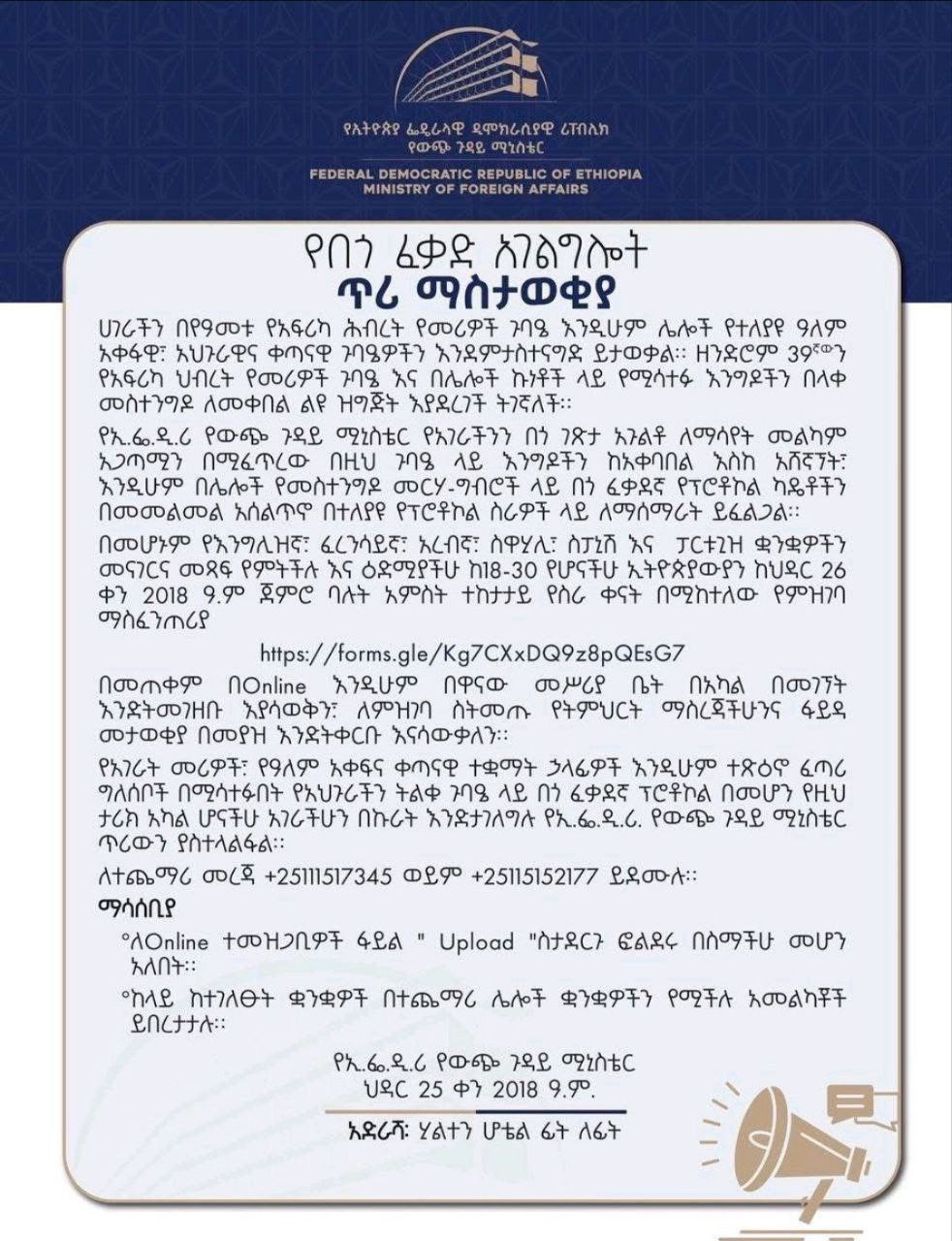
How to Apply
Interested applicants can register either online or in person.
Option 1: Online Registration
Click the link below to fill out the official Google Form:

Option 2: In-Person Registration
You can register at the Ministry of Foreign Affairs Headquarters in Addis Ababa.
Required Documents:
- Valid ID Card or Passport.
- Educational Certificates (Original + Copy).
Registration Start Date: November 26, 2025
Please register as soon as possible as spaces are limited.
Ethiopia Slams Egypt’s “Colonial Mentality” Ahead of Critical Nile Talks
Addis Ababa | December 04, 2025
Addis Ababa — In a strongly worded statement issued yesterday, Ethiopia’s Ministry of Foreign Affairs (MFA) has categorically condemned Egypt’s refusal to engage in modern dialogue regarding the Nile River, accusing Cairo of clinging to “colonial-era mentality” and obstructing African progress.
The statement comes at a pivotal moment, just days before decisive meetings in Burundi that are expected to determine the future of the Cooperative Framework Agreement (CFA) and the operationalization of the Nile River Basin Commission (NRBC).
Why This Matters Now:
This week’s meetings in Burundi could be a turning point. If the CFA is fully operationalized, it will establish a new legal order for the Nile Basin—one that removes Egypt’s historic “veto power” and allows upstream countries like Ethiopia to utilize water resources equitably.
Rejection of “Historic Rights”
For decades, Egypt has relied on colonial treaties from 1929 and 1959 to claim a monopoly over the Nile waters. These treaties allocated the vast majority of water to Egypt and Sudan, completely ignoring upstream nations like Ethiopia, which contributes 86% of the Nile’s water.
“Egypt pretended to engage in negotiations while it obstructed progress… The policy of pretending to negotiate while refusing to engage in meaningful dialogue has now been made public.”
— Ministry of Foreign Affairs, Ethiopia
Ethiopia argues that these claims are incompatible with the 21st century. The Ministry stated that Egypt’s “hostile rhetoric” is a symptom of its inability to accept the principle of Fair, Reasonable, and Equitable Utilization—a cardinal principle of modern international law.
GERD: A Symbol of Self-Reliance
Responding to recent Egyptian allegations that the Grand Ethiopian Renaissance Dam (GERD) is “larger than needed” and a tool for “political dominance,” Ethiopia fired back.
The Ministry clarified that the GERD is not a tool of aggression but an embodiment of Africa’s self-reliance. Ethiopia reiterated that it has no obligation to seek permission to use natural resources within its own borders to generate energy for its people.
Key Differences: Ethiopia vs. Egypt
| Ethiopia’s Position | Egypt’s Position |
|---|---|
| Legal Basis: Equitable and Reasonable Utilization (CFA). | Legal Basis: Historic Rights & Colonial Treaties (1929/1959). |
| Goal: Shared energy generation and regional integration. | Goal: Maintaining current water quotas and veto power. |
| Philosophy: Pan-Africanism and Cooperation. | Philosophy: Monopoly and Status Quo. |
A Pan-African Shift
The statement frames the current diplomatic struggle not just as a water dispute, but as a fight against the vestiges of colonialism. By invoking its history of supporting anti-colonial struggles, Ethiopia is rallying other riparian states to move forward with the Nile River Basin Commission (NRBC) without waiting for Egypt’s approval.
As the Burundi meetings approach, the message from Addis Ababa is unequivocal: “Ethiopia stands firm in assertion of its right to utilize the Abbay River.”
Stay tuned for updates on the Burundi consultations later this week.